Latest Amazon SAA-C03 Exam Review | New SAA-C03 Test Papers
Wiki Article
P.S. Free 2026 Amazon SAA-C03 dumps are available on Google Drive shared by BraindumpsPrep: https://drive.google.com/open?id=1DzPwtve3fXb1orlsE0_RkrQ1WNf9SMsd
BraindumpsPrep is a legal authorized company offering the best Amazon SAA-C03 test preparation materials. So for some candidates who are not confident for real tests or who have no enough to time to prepare I advise you that purchasing valid and Latest SAA-C03 Test Preparation materials will make you half the efforts double the results. Our products help thousands of people pass exams and can help you half the work with double the results.
Achieving the Amazon SAA-C03 Certification demonstrates that an individual has the skills and expertise needed to design and deploy scalable, highly available, and fault-tolerant systems on AWS. It is a valuable credential for IT professionals who want to advance their careers and take on more challenging roles in cloud computing.
>> Latest Amazon SAA-C03 Exam Review <<
Pass Guaranteed 2026 Amazon SAA-C03 Updated Latest Exam Review
Our company is a professional copyright materials provider, we have occupied in the field for years, and we also famous for providing high-quality exam dumps. SAA-C03 training materials have the questions and answers, and it will be convenient for you to check your answer. In addition, the pass rate for SAA-C03 Exam copyright is 98.75%, and we can guarantee you copyright just one time. If you fail to copyright, we will refund your money. We also offer you free update for one year after purchasing, and the update version for SAA-C03 training materials will be sent to you automatically.
Amazon SAA-C03 Certification Exam is a highly sought-after certification for professionals who want to validate their skills in designing and deploying scalable, highly available, and fault-tolerant systems on Amazon Web Services (AWS). The SAA-C03 exam is the updated version of the previous SAA-C02 exam and is designed to test a candidate's ability to design and implement solutions that meet customer requirements using AWS services and technologies.
The SAA-C03 exam consists of multiple-choice and multiple-response questions, and it covers a range of topics related to AWS services, including compute, storage, database, networking, security, and AWS cost management. SAA-C03 Exam is intended for individuals who have at least one year of hands-on experience designing and deploying scalable, highly available, and fault-tolerant systems on AWS. AWS Certified Solutions Architect - Associate certification is highly valued by organizations that use AWS as their cloud platform and by professionals who want to advance their careers in the field of cloud computing.
Amazon AWS Certified Solutions Architect - Associate Sample Questions (Q875-Q880):
NEW QUESTION # 875
A mining company is using Amazon S3 as its data lake. The company wants to analyze the data collected by the sensors in its mines. A data pipeline is being built to capture data from the sensors, ingest the data into an S3 bucket, and convert the data to Apache Parquet format. The data pipeline must be processed in near-real time. The data will be used for on-demand queries with Amazon Athena. Which solution will meet these requirements?
- A. Use AWS DataSync to invoke an AWS Lambda function that converts the data to Parquet format and stores the data in Amazon S3.
- B. Use Amazon Simple Queue Service (Amazon SQS) to stream data directly to an AWS Glue job that converts the data to Parquet format and stores the data in Amazon S3.
- C. Use Amazon Kinesis Data Streams to invoke an AWS Lambda function that converts the data to Parquet format and stores the data in Amazon S3.
- D. Use Amazon Data Firehose to invoke an AWS Lambda function that converts the data to Parquet format and stores the data in Amazon S3.
Answer: D
Explanation:
Amazon Kinesis Data Firehose (now known as Amazon Data Firehose) supports near-real-time streaming, with built-in support to:
Invoke AWS Lambda functions for transformation.
Store data directly into Amazon S3 in desired formats like Apache Parquet.
"You can use Data Firehose to transform the data before delivering it, by invoking a Lambda function. You can convert to formats such as JSON or Apache Parquet before storing it into S3." Why not the others?
B: Kinesis Data Streams requires more operational overhead than Firehose.
C: DataSync is for file movement--not stream processing.
D: SQS isn't designed for streaming and transformation pipelines.
NEW QUESTION # 876
The customers of a finance company request appointments with financial advisors by sending text messages. A web application that runs on Amazon EC2 instances accepts the appointment requests. The text messages are published to an Amazon Simple Queue Service (Amazon SQS) queue through the web application. Another application that runs on EC2 instances then sends meeting invitations and meeting confirmation email messages to the customers. After successful scheduling, this application stores the meeting information in an Amazon DynamoDB database.
As the company expands, customers report that their meeting invitations are taking longer to arrive. What should a solutions architect recommend to resolve this issue?
- A. Add an Amazon API Gateway API in front of the web application that accepts the appointment requests.
- B. Add an Auto Scaling group for the application that sends meeting invitations. Configure the Auto Scaling group to scale based on the depth of the SQS queue.
- C. Add a DynamoDB Accelerator (DAX) cluster in front of the DynamoDB database.
- D. Add an Amazon CloudFront distribution. Set the origin as the web application that accepts the appointment requests.
Answer: B
Explanation:
For SQS-backed worker architectures, AWS recommends scaling consumers based on queue metrics (e.g., ApproximateNumberOfMessagesVisible, AgeOfOldestMessage). EC2 Auto Scaling can "scale out based on Amazon CloudWatch alarms" tied to SQS backlog, increasing worker capacity to reduce latency as demand grows. DAX (A) accelerates DynamoDB reads, not message processing. API Gateway (B) and CloudFront (C) optimize request ingress and content delivery, not the asynchronous email-sending application. The bottleneck is consumer throughput; scaling workers with an SQS- driven policy restores timely processing without downtime and follows Well-Architected patterns for decoupled, elastic systems.
NEW QUESTION # 877
The media company that you are working for has a video transcoding application running on Amazon EC2. Each EC2 instance polls a queue to find out which video should be transcoded, and then runs a transcoding process. If this process is interrupted, the video will be transcoded by another instance based on the queuing system. This application has a large backlog of videos which need to be transcoded. Your manager would like to reduce this backlog by adding more EC2 instances, however, these instances are only needed until the backlog is reduced.
In this scenario, which type of Amazon EC2 instance is the most cost-effective type to use?
- A. Reserved instances
- B. Dedicated instances
- C. Spot instances
- D. On-demand instances
Answer: C
Explanation:
You require an instance that will be used not as a primary server but as a spare compute resource to augment the transcoding process of your application. These instances should also be terminated once the backlog has been significantly reduced. In addition, the scenario mentions that if the current process is interrupted, the video can be transcoded by another instance based on the queuing system. This means that the application can gracefully handle an unexpected termination of an EC2 instance, like in the event of a Spot instance termination when the Spot price is greater than your set maximum price.
Hence, an Amazon EC2 Spot instance is the best and cost-effective option for this scenario.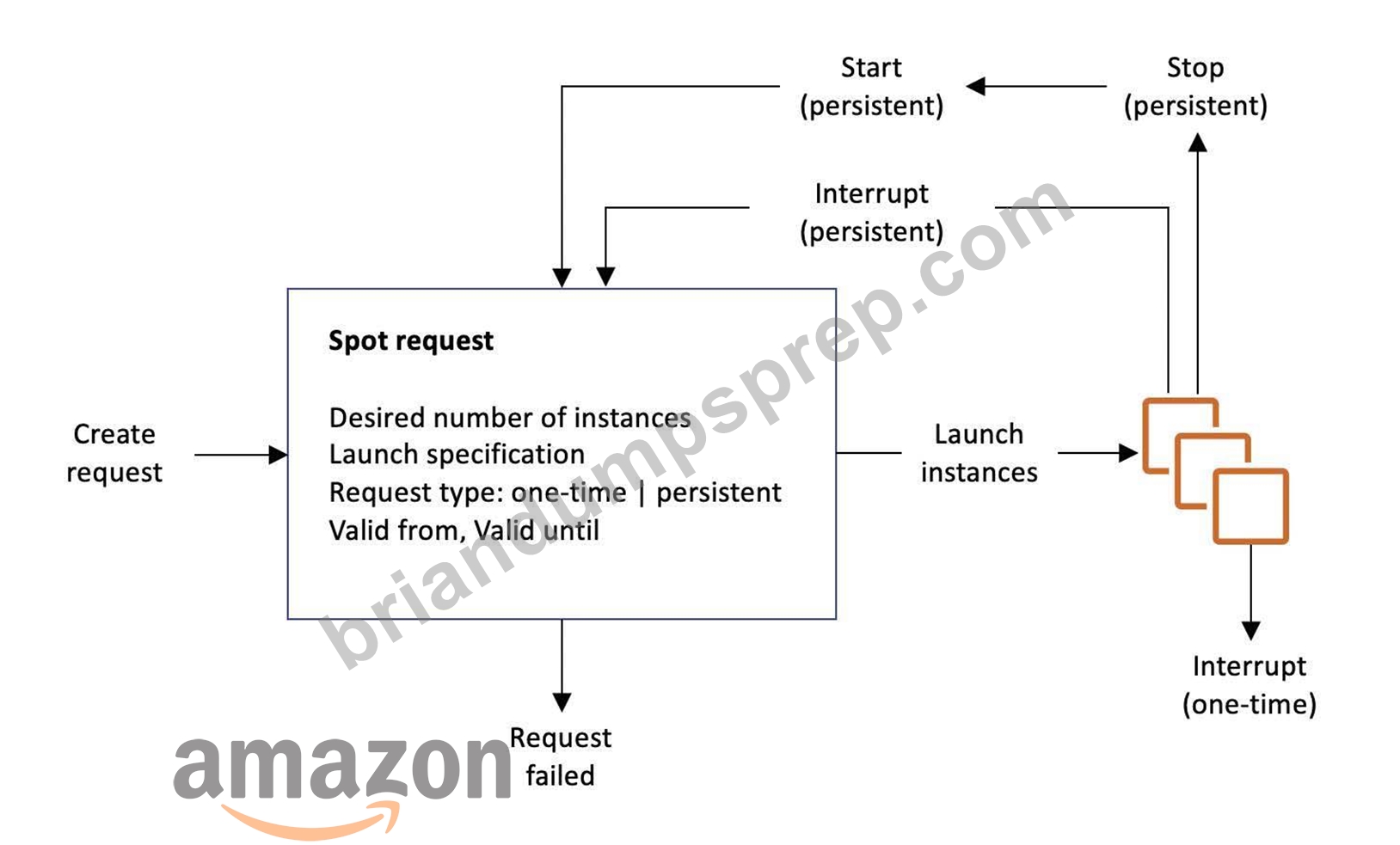
Amazon EC2 Spot instances are spare compute capacity in the AWS cloud available to you at steep discounts compared to On-Demand prices. EC2 Spot enables you to optimize your costs on the AWS cloud and scale your application's throughput up to 10X for the same budget. By simply selecting Spot when launching EC2 instances, you can save up-to 90% on On-Demand prices. The only difference between On-Demand instances and Spot Instances is that Spot instances can be interrupted by EC2 with two minutes of notification when the EC2 needs the capacity back.
You can specify whether Amazon EC2 should hibernate, stop, or terminate Spot Instances when they are interrupted. You can choose the interruption behavior that meets your needs.
Take note that there is no "bid price" anymore for Spot EC2 instances since March 2018. You simply have to set your maximum price instead.
Reserved instances and Dedicated instances are incorrect as both do not act as spare compute capacity.
On-demand instances is a valid option but a Spot instance is much cheaper than On-Demand.
References:
https://docs.aws.amazon.com/AWSEC2/latest/UserGuide/spot-interruptions.html
http://docs.aws.amazon.com/AWSEC2/latest/UserGuide/how-spot-instances-work.html
https://aws.amazon.com/blogs/compute/new-amazon-ec2-spot-pricing
Check out this Amazon EC2 Cheat Sheet:
https://tutorialsdojo.com/amazon-elastic-compute-cloud-amazon-ec2/
NEW QUESTION # 878
A company has developed a non-production application that is composed of multiple microservices for each of the company's business units. A single development team maintains all the microservices.
The current architecture uses a static web frontend and a Java-based backend that contains the application logic. The architecture also uses a MySQL database that the company hosts on an Amazon EC2 instance.
The company needs to ensure that the application is secure and available globally.
Which solution will meet these requirements with the LEAST operational overhead?
- A. Use Amazon CloudFront and Amazon S3 to host the static web frontend. Refactor the microservices to use AWS Lambda functions that are in a target group behind a Network Load Balancer. Migrate the MySQL database to Amazon RDS for MySQL.
- B. Use Amazon CloudFront and AWS Amplify to host the static web frontend. Refactor the microservices to use AWS Lambda functions that the microservices access by using Amazon API Gateway. Migrate the MySQL database to an Amazon EC2 Reserved Instance.
- C. Use Amazon CloudFront and Amazon S3 to host the static web frontend. Refactor the microservices to use AWS Lambda functions that the microservices access by using Amazon API Gateway. Migrate the MySQL database to Amazon RDS for MySQL.
- D. Use Amazon S3 to host the static web frontend. Refactor the microservices to use AWS Lambda functions that are in a target group behind an Application Load Balancer. Migrate the MySQL database to an Amazon EC2 Reserved Instance.
Answer: C
Explanation:
This solution offers the least operational overhead while meeting the security and global availability requirements:
* Amazon CloudFront and S3: Hosting the static frontend on S3 and serving it via CloudFront provides low-latency global distribution, high availability, and security. S3 is a cost-effective and serverless option for hosting static assets, and CloudFront ensures that the application is cached closer to the users, reducing latency globally.
* AWS Lambda and API Gateway: Refactoring the microservices to use Lambda functions with API Gateway allows for a fully serverless, scalable, and highly available backend. This reduces the need for managing EC2 instances, as Lambda automatically scales to meet demand and only charges for the actual usage.
* RDS for MySQL: Migrating the MySQL database from an EC2 instance to Amazon RDS significantly reduces operational overhead. RDS manages backups, patching, and scaling, and it offers high availability options (e.g., Multi-AZ).
* Option A and D involve using EC2 Reserved Instances for the database, which requires more operational maintenance than using RDS.
* Option C suggests using a Network Load Balancer with Lambda, which adds unnecessary complexity for this use case.
AWS References:
* Amazon S3 and CloudFront Integration
* AWS Lambda with API Gateway
* Amazon RDS for MySQL
NEW QUESTION # 879
A company needs to move data from an Amazon EC2 instance to an Amazon S3 bucket. The company must ensure that no API calls and no data are routed through public internet routes. Only the EC2 instance can have access to upload data to the S3 bucket.
Which solution will meet these requirements?
- A. Create a gateway VPC endpoint for Amazon S3 in the Availability Zone where the EC2 instance is located. Attach appropriate security groups to the endpoint. Attach a resource policy lo the S3 bucket to only allow the EC2 instance's IAM role for access.
- B. Create an interface VPC endpoint for Amazon S3 in the subnet where the EC2 instance is located.
Attach a resource policy to the S3 bucket to only allow the EC2 instance's IAM role for access. - C. Use the AWS provided, publicly available ip-ranges.json tile to obtain the private IP address of the S3 bucket's service API endpoint. Create a route in the VPC route table to provide the EC2 instance with access to the S3 bucket. Attach a resource policy to the S3 bucket to only allow the EC2 instance's IAM role for access.
- D. Run the nslookup tool from inside the EC2 instance to obtain the private IP address of the S3 bucket's service API endpoint. Create a route in the VPC route table to provide the EC2 instance with access to the S3 bucket. Attach a resource policy to the S3 bucket to only allow the EC2 instance's IAM role for access.
Answer: B
Explanation:
Explanation
(https://aws.amazon.com/blogs/security/how-to-restrict-amazon-s3-bucket-access-to-a-specific-iam-role/)
NEW QUESTION # 880
......
New SAA-C03 Test Papers: https://www.briandumpsprep.com/SAA-C03-prep-exam-copyright.html
- Pass Guaranteed Amazon - SAA-C03 - AWS Certified Solutions Architect - Associate –Trustable Latest Exam Review ???? Open [ www.exam4labs.com ] enter ⇛ SAA-C03 ⇚ and obtain a free download ⌚SAA-C03 Interactive EBook
- Quiz 2026 SAA-C03: Authoritative Latest AWS Certified Solutions Architect - Associate Exam Review ???? The page for free download of ⮆ SAA-C03 ⮄ on ➠ www.pdfvce.com ???? will open immediately ????SAA-C03 Certification Exam Infor
- Quiz 2026 SAA-C03: Authoritative Latest AWS Certified Solutions Architect - Associate Exam Review ⏩ Download ⮆ SAA-C03 ⮄ for free by simply searching on ✔ www.pdfdumps.com ️✔️ ????SAA-C03 Reliable Dumps Free
- 2026 Efficient SAA-C03 – 100% Free Latest Exam Review | New AWS Certified Solutions Architect - Associate Test Papers ???? Open [ www.pdfvce.com ] and search for { SAA-C03 } to download exam materials for free ????SAA-C03 Interactive EBook
- 100% Pass Quiz Amazon - Updated Latest SAA-C03 Exam Review ???? Search for ➤ SAA-C03 ⮘ on { www.practicevce.com } immediately to obtain a free download ????Valid SAA-C03 Test Syllabus
- Test SAA-C03 Dumps Pdf ???? SAA-C03 Valid copyright ???? SAA-C03 Valid Exam Cram ???? Open website ⏩ www.pdfvce.com ⏪ and search for 【 SAA-C03 】 for free download ????SAA-C03 Test Testking
- Experience The Real Environment With The Help Of Amazon SAA-C03 Exam Questions ???? Search on ➽ www.examcollectionpass.com ???? for ▷ SAA-C03 ◁ to obtain exam materials for free download ⚒Test SAA-C03 Book
- Study SAA-C03 Tool ???? Study SAA-C03 Tool ???? SAA-C03 Latest copyright Free ???? Immediately open ➡ www.pdfvce.com ️⬅️ and search for ✔ SAA-C03 ️✔️ to obtain a free download ????SAA-C03 Test Answers
- Quiz Marvelous Amazon Latest SAA-C03 Exam Review ???? ✔ www.practicevce.com ️✔️ is best website to obtain ▷ SAA-C03 ◁ for free download ????SAA-C03 Reliable Dumps Free
- 100% Pass Authoritative Amazon - SAA-C03 - Latest AWS Certified Solutions Architect - Associate Exam Review ???? Enter ⏩ www.pdfvce.com ⏪ and search for ☀ SAA-C03 ️☀️ to download for free ????SAA-C03 Reliable Mock Test
- Experience The Real Environment With The Help Of Amazon SAA-C03 Exam Questions ???? Search for ▷ SAA-C03 ◁ and download it for free on ✔ www.troytecdumps.com ️✔️ website ????Pass SAA-C03 Guarantee
- darrencqbu550336.hazeronwiki.com, ezmarkbookmarks.com, matheajhy376755.laowaiblog.com, www.stes.tyc.edu.tw, susangobh688105.blognody.com, geraldtddh739752.blogaritma.com, social-lyft.com, carastcl594276.bloggerbags.com, www.stes.tyc.edu.tw, alexiaebmb367951.bloguerosa.com, Disposable vapes
DOWNLOAD the newest BraindumpsPrep SAA-C03 copyright from Cloud Storage for free: https://drive.google.com/open?id=1DzPwtve3fXb1orlsE0_RkrQ1WNf9SMsd
Report this wiki page